
Every year, thousands of ambitious founders, operators, and builders spend months writing code, designing logos, and drafting company registrations—only to launch to complete silence. According to extensive research across startup failure rates, over 42% of failed ventures cite building something nobody actually wanted as their primary cause of death.
The impulse to build immediately is natural. When a novel idea strikes, builders gravitate toward what they control best: design, engineering, and product features. However, premature execution is one of the most expensive mistakes you can make in business.
Validation is the disciplined process of answering a fundamental commercial question before risking your savings or your time:
Are there real people with an acute, frequent problem who are actively searching for a solution and willing to pay you to solve it?
This guide provides a comprehensive, field-tested operational blueprint to systematically stress-test your business concept in 30 days.
1. Start With the Problem, Not the Solution

The most dangerous cognitive trap in entrepreneurship is falling in love with your own solution. When you start with a preconceived product, every observation is filtered through confirmation bias.
Instead of asking "What features should my product have?", high-conviction operators ask:
- What is the specific bottleneck or pain point?
- Who suffers from this pain point most acutely?
- What is the quantifiable cost of doing nothing?
The Three-Part Problem Severity Test
Not all business problems are created equal. To determine whether an idea has commercial legs, evaluate it against three core dimensions:
- Frequency: Does this friction occur multiple times daily, weekly, or once every three years? Frequent problems build habitual usage and higher customer lifetime value.
- Intensity: Is this a mild annoyance or a hair-on-fire crisis that disrupts operations, costs revenue, or risks compliance?
- Cost of Inaction: If the prospect ignores this problem for the next 12 months, what happens? If the answer is "not much," they will never prioritize purchasing your product.
2. Identify Your Target Customer

A business idea targeted at "everyone" is guaranteed to resonate with no one. When your audience definition is too broad, your marketing messaging becomes generic, your feature set balloons, and your customer acquisition costs skyrocket.
To validate effectively, you must define a tight Ideal Customer Profile (ICP).
Narrowing Down to an Actionable ICP
Instead of defining your customer as:
"Small business owners who want to manage their social media."
Narrow your target segment to:
"Solo dental clinic practitioners in Tier 1 cities with 2 to 5 staff members who currently waste 6 hours a week attempting to create local patient awareness."
By narrowing your focus:
- You know exactly where to find them (dental associations, Google Maps, local directories).
- You speak their specific operational language.
- You can compare your offering directly against what they use today.
3. Research the Market and Your Competitors

When prospective founders announce, "We have no competitors—nobody else is doing this," it is almost never good news.
In practice, a lack of competitors indicates one of two realities:
- You have not researched properly.
- Others tried, discovered there was no paying demand, and quietly shut down.
Competitors validate that a market exists and that customers have allocated budget for solutions in your category.
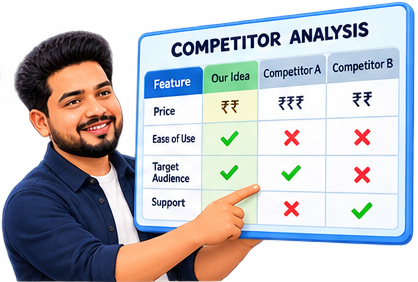
Building a Competitor Matrix
Audit 3 to 5 direct and indirect competitors across four critical pillars:
| Evaluation Pillar | Incumbent Competitors | Your Proposed Approach | | :--- | :--- | :--- | | Pricing Model | High enterprise contracts or confusing tiered tiers | Transparent, predictable unit-based or monthly pricing | | Ease of Use | Heavy, complex onboarding requiring weeks of training | Streamlined, zero-code onboarding in under 15 minutes | | Target Audience | Broad enterprise or mid-market accounts | Under-served niche operators with specialized workflows | | Customer Support | Automated ticket queues with multi-day turnaround | Direct WhatsApp/Slack access with rapid SLA resolution |
Look specifically for 1-star and 2-star reviews of existing solutions on platforms like G2, Capterra, Google Reviews, or Reddit. Those complaints highlight the exact product gaps your offering can exploit.
4. Interview Potential Customers

Customer discovery interviews are the single most valuable data source in early-stage business validation. However, most founders conduct them incorrectly by pitching their concept rather than listening to actual problems.
The Rules of Objective Discovery
To avoid false positive feedback, follow the core tenets of The Mom Test:
- Never ask if they would buy your idea. People want to be polite and will say "yes" because compliments cost them nothing.
- Talk about their current life and past behavior, not future speculation. How they solved the problem last week is an accurate predictor of what they will do next week.
- Listen 80% of the time, speak 20%. If you spend the interview explaining your vision, you are selling, not learning.
Five Essential Discovery Questions
- "Walk me through the last time you had to deal with [problem]?"
- "What made that process particularly frustrating or expensive?"
- "What workarounds, software, or internal spreadsheets do you currently use to handle it?"
- "How much time or money does your team spend on that workaround each month?"
- "What have you already tried that didn't work, and why did you stop using it?"
If a prospect has never spent a dollar, built a spreadsheet, or searched Google for a workaround, the problem is not painful enough to build a business around.
5. Test Your Solution Before Building the Complete Product

You do not need six months of software engineering to test customer appetite. Modern operators use low-fidelity experiments to confirm demand before writing a line of production code.

Four Lean Testing Formats
- The Smoke Test Landing Page: Build a single-page website clearly articulating the value proposition, target customer, key outcomes, and a prominent "Request Early Access" or "Join Pilot" button.
- The Concierge MVP: Provide the intended service completely by hand. If you want to build an AI recruitment matching platform, manually curate 10 candidate resumes for three hiring managers and deliver them via email.
- The Wizard of Oz Test: Give the illusion of an automated backend while fulfilling orders behind the curtain manually. This validates operational feasibility and pricing appetite before writing custom software.
- Interactive Clickable Wireframes: Use Figma or interactive mockups during a screen-share session. Observe where prospects click naturally, what confuses them, and whether the workflow solves their immediate challenge.
6. Test Whether Customers Will Actually Pay

Verbal praise is the cheapest currency in the world. The only definitive metric of commercial validation is a customer parting with capital, signing a legally binding agreement, or investing non-trivial operational time.
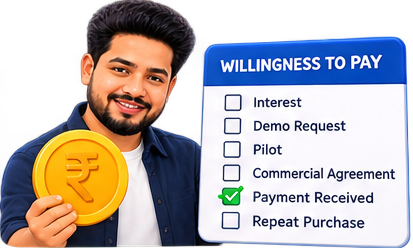
The Willingness-to-Pay Ladder
Evaluate customer conviction across six distinct levels:
- Casual Interest: "Sounds cool, let me know when it launches." (Worth 0 validation points).
- Time Investment: Prospect attends a 45-minute workflow deep-dive and shares internal documentation.
- Formal Demo Request: Prospect brings their team lead or decision-maker into the conversation.
- Letter of Intent (LOI): Signed non-binding statement agreeing to purchase upon delivery of defined specifications.
- Paid Pilot / Upfront Deposit: Prospect transfers funds or pays an onboarding fee for early deployment.
- Repeat Purchase / Renewal: Customer continues paying after the initial introductory cycle.
7. Check Whether the Business Can Make Money

A business can have real customer demand and still be a terrible business if the unit economics do not work.
Before committing capital, verify whether each unit sold leaves sufficient contribution margin to cover fixed overheads, customer acquisition costs, and taxes.
Unit Economics & Break-Even Framework
Average monthly realized price
Hosting, APIs, payment fee, fulfillment
Surplus available per customer
Until reaching 50 customers, each new subscriber pays down fixed infrastructure. Beyond customer 51, every additional account contributes ₹1,300 straight to operational profit.
Understanding the Financial Mechanics
- Selling Price (₹2,000): The gross price charged per customer per billing period.
- Variable Cost (₹700): The direct cost incurred solely when serving that customer (server bandwidth, direct third-party API fees, payment gateway cuts, packaging, or direct fulfillment labor).
- Contribution Margin (₹1,300 / 65%): The gross surplus generated by each customer to pay down overheads.
- Fixed Overhead (₹65,000/month): Rent, baseline software tooling, foundational accounting, and minimum living stipend.
- Break-Even Volume (50 Customers): The minimum baseline customer count required each month before generating ₹1 of net profit.
Ask yourself honestly:
Can I realistically acquire and support 50 paying customers within my target segment using my planned marketing channels?
8. Validate Your Customer Acquisition Strategy

Building a product that nobody discovers is identical to not building it at all. A complete validation process must validate your distribution channel alongside the product concept.
The Four-Stage Growth Funnel
- Acquisition: Where do your target prospects spend time, and can you reach them affordably (outbound email, LinkedIn, SEO, partnerships, paid ads)?
- Conversion: When prospects land on your offer, do they understand the value proposition and take immediate action?
- Revenue: What percentage of qualified leads convert into cash-paying customers?
- Retention: Do customers stick around long enough for Customer Lifetime Value (LTV) to exceed Customer Acquisition Cost (CAC) by at least 3:1?
If acquiring a ₹2,000/month customer costs ₹10,000 in advertising and they churn after two months, your business model is commercially unviable.
9. Create a Clear Validation Experiment
Never embark on a validation cycle without defining strict pass/fail criteria in advance. Without predetermined thresholds, human psychology will rationalize mediocre feedback as proof of success.
Structuring a Falsifiable Hypothesis
Use this exact operational template:
HYPOTHESIS STATEMENT:
We believe that [Target Customer Segment]
experiences acute friction with [Specific Problem].

EXPERIMENT DESIGN:
We will test this by reaching out to [50 ICP Prospects]
offering [Specific Value Proposition & Concierge Solution].

VALIDATION THRESHOLD (PASS CRITERIA):
- Minimum 25% response rate (12+ interviews booked).
- At least 5 prospects explicitly rank this problem as a top-3 priority.
- At least 3 prospects agree to pay a ₹5,000 upfront pilot deposit.

DECISION DEADLINE:
30 Days from launch.
If the experiment hits your threshold, proceed to the next stage. If it falls short, adjust the offer or stop before spending further capital.
10. Follow a Practical 30-Day Validation Plan
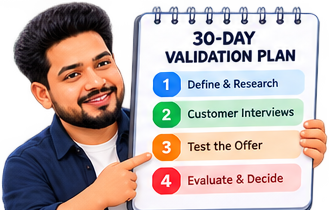
To prevent validation from dragging on indefinitely, execute within a strict four-week timeline:
Week 1 (Days 1–7): Define & Research
- Draft your Problem Canvas and target ICP criteria.
- Conduct competitor auditing and identify gaps in existing solutions.
- Compile a target prospect list of 50 verified contact profiles.
Week 2 (Days 8–15): Customer Discovery
- Conduct 15 to 25 non-leading customer interviews.
- Document recurring objections, current workarounds, and budget allocations.
- Eliminate assumptions that customers did not validate during calls.
Week 3 (Days 16–23): Test the Offer
- Build a lightweight landing page or 5-slide commercial pilot pitch deck.
- Present your proposed solution and pricing directly to your interviewed prospects.
- Request explicit commitments: deposits, LOIs, or paid pilot signups.
Week 4 (Days 24–30): Evaluate & Decide
- Tally your conversion rates, customer feedback, and unit economics.
- Calculate break-even volume against verified pricing appetite.
- Make the formal Proceed, Pivot, or Stop determination.
11. Decide Whether to Proceed, Pivot, or Stop

At the conclusion of your 30-day experiment, review the data objectively and choose one of three distinct paths:
1. Proceed (Green Light)
- Customers confirmed the problem is urgent and frequent.
- Multiple independent buyers committed capital or signed agreements.
- Unit economics project a healthy contribution margin.
- Next Step: Build the minimal functional MVP to fulfill commitments.
2. Pivot (Iterate & Refine)
- Customers confirmed an acute problem exists, but rejected your proposed delivery format or pricing model.
- Or, your initial target segment lacked budget, but an adjacent audience showed strong demand.
- Next Step: Adjust the customer segment or value proposition and run a focused 14-day re-test.
3. Stop (Cut Losses Early)
- Customers showed lukewarm interest, have adequate free workarounds, and refused to pay.
- Acquisition costs are prohibitive and unit economics cannot scale.
- Next Step: Celebrate killing a bad idea early. You have saved months of your life and hundreds of thousands of rupees. Move on to your next concept with full energy.
12. Common Business Idea Validation Mistakes
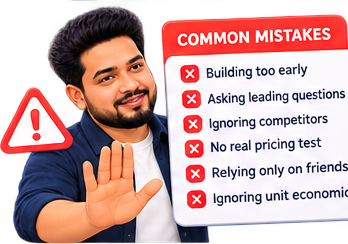
Even well-intentioned entrepreneurs frequently fall prey to avoidable validation mistakes:
- Building Too Early: Writing code, creating design systems, or ordering inventory before confirming customer willingness to pay.
- Asking Leading Questions: Asking "Don't you think an automated dashboard would make your life easier?" instead of exploring actual workflow reality.
- Ignoring Competitors: Dismissing established market leaders rather than understanding why customers currently choose them.
- Accepting Verbal Compliments: Counting social media likes or casual encouragement as evidence of business demand.
- Interviewing Friends and Family: Surveying people who love you and will never give you the brutal truth about your business model.
- Ignoring Unit Economics: Focusing purely on top-line user signups while ignoring the direct variable costs required to service them.
13. Business Idea Validation Checklist
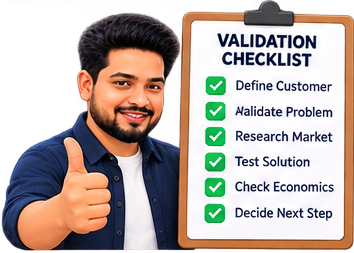
Use this interactive checklist to audit your idea's validation readiness:
Idea Validation Readiness Checklist
14. Frequently Asked Questions
How long should business idea validation take?↓
What is the single biggest difference between customer interest and willingness to pay?↓
Can I validate an idea without any coding skills or technical background?↓
When should I pivot versus stop working on an idea completely?↓
How many customer discovery interviews are enough?↓
15. Final Thoughts

Business idea validation is not an academic exercise designed to guarantee that your business cannot fail. Entrepreneurship will always involve risk, uncertainty, and unexpected market dynamics.
Rather, validation is insurance against unforced errors. It guarantees that when you finally do sit down to build, invest capital, and rally partners, you are building on the solid bedrock of verified customer demand rather than hopeful speculation.

Measure early, listen honestly, and let real customers guide your commercial trajectory.
16. References and Further Reading
-
Blank, Steve. Why the Lean Start-Up Changes Everything. Harvard Business Review, May 2013.
Read at Harvard Business Review ↗ — The landmark essay defining the methodology of customer discovery, hypothesis testing, and agile venture building over traditional business planning. -
Fitzpatrick, Rob. The Mom Test: How to talk to customers & learn if your business is a good idea when everyone is lying to you.
Visit The Mom Test Official Site ↗ — The essential practical guide for founders on how to ask objective, non-leading questions that uncover genuine customer behavior without pitching. -
Ries, Eric. The Lean Startup: How Today's Entrepreneurs Use Continuous Innovation to Create Radically Successful Businesses. Crown Business.
Explore The Lean Startup Resources ↗ — The foundational text introducing the Build-Measure-Learn feedback loop, minimum viable products, and actionable metrics.